2025 Federal Information Return Reporting Considerations

January 5, 2026

by Mary C. Walsh, JD, LL.M, CPA (FL)


As the tax filing season looms, employers must ensure compliance with federal information reporting requirements, including payroll and payment reporting to the government, employees, and other income recipients.  Most of forms are required to be electronically filed.  In 2026, there are new requirements for reporting employee tips and overtime. This article provides details regarding these reporting obligations.

General Federal Year-end Information Return Filing Requirements for Forms W-2, W-3, and 1099 (INT, NEC & MISC)


  • Electronic filing is required if at least 10 of the following forms, combined, are required to be filed: W-2, 1094, 1095-B, 1095-C, 1097-BTC, 1098, 1098-C, 1098-E, 1098-Q, 1098T, 1099, 3921, 3922, 5498, 9027, W02G and 499R-2/W-2PR.
  • In some cases, electronic filing is given more time to file with the IRS than paper filing.
  • Filing and due date information is set forth in IRS Publication 509, Tax Calendars for use in 2026 (https://www.irs.gov/pub/irs-pdf/p509.pdf). See also IRS Publication 1220, Specifications for Electronic Filing of Forms 1097, 1098, 1099, 3921, 3922, 5498, and W-2G, which sets forth electronic filing format specifications.
  • Typically, due dates fall at the end of a month. However, if a due date is a weekend day or holiday, the next business day becomes the due date. Also, Congress or the President may specify a different due date, e.g., if there is an emergency. In 2026:
  • 1/31/2026 is a Saturday, making 2/2/2026 the next business day, and
  • 2/28/2026 is a Saturday, making 3/2/2026 the next business day.
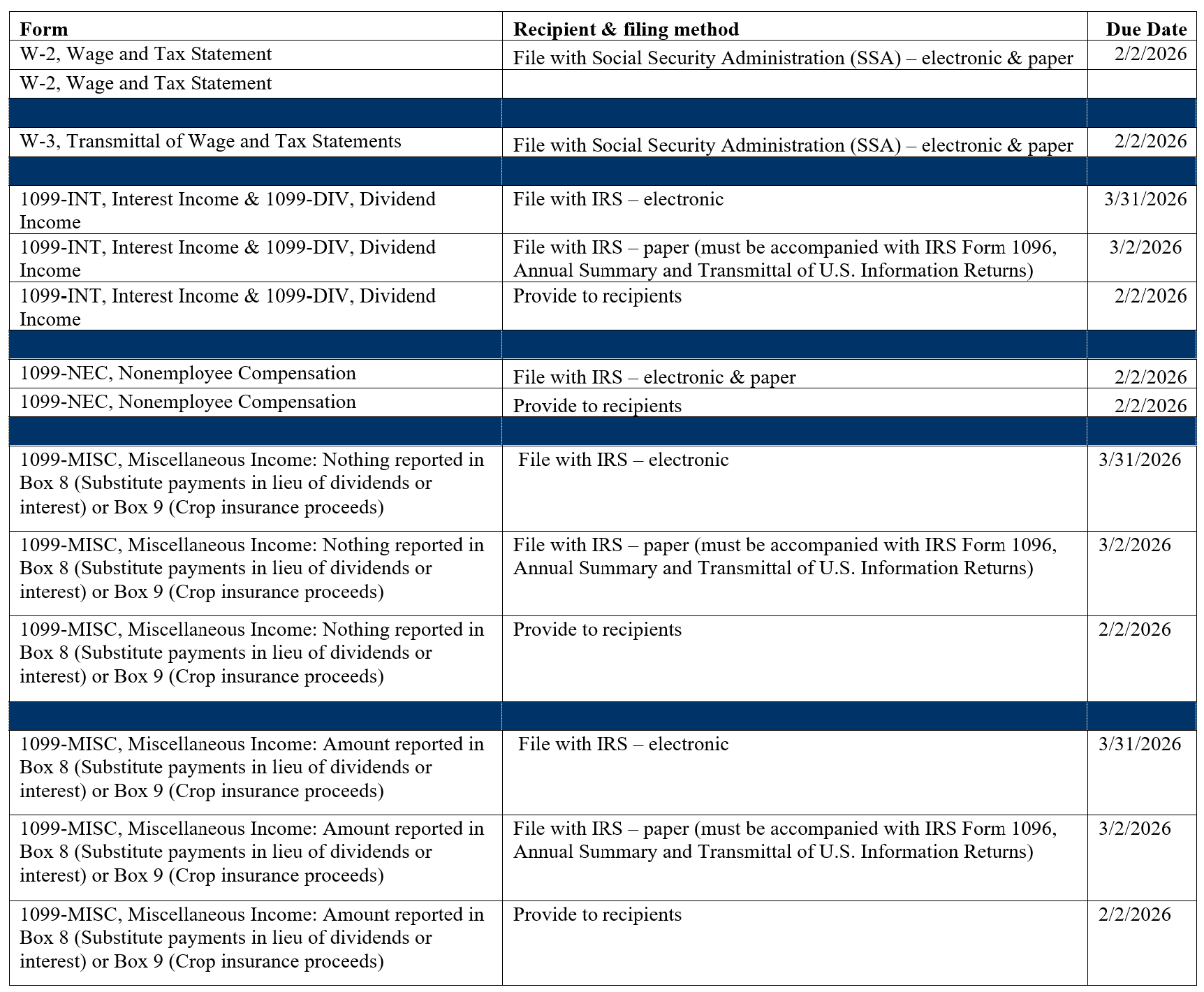
  • Currently, information reporting due dates for 2026 are:


Special Issue - Tips & Overtime


Federal: The One Big Beautiful Bill Act (OBBBA) enacted in July 2025, allows certain employees to deduct tips and overtime compensation. One area of uncertainty, affecting both employers and employees, regards 2025 payroll reporting for tips and overtime.


Under the OBBBA, from 2025 to 2028, certain employees who receive qualified:

  • tips may deduct up to $25,000 of those tips, and/or
  • overtime pay may deduct up to $12,500 of qualified overtime compensation ($25,000 for joint filers).


To enable employees to report their deduction, the OBBBA requires employers to provide separate accounting of the total amount of cash tips and overtime. Employers failing to comply with these reporting requirements may be subject to penalties.


Although the IRS has released a draft version of Form W-2 for 2026 reflecting OBBBA changes, the 2025 version of the form will not be updated, creating a challenge for employer reporting compliance. As a result, for tax year 2025, the IRS announced in that employers will not face penalties for failing to provide required tip and overtime accounting to employees (Notice 2025-62). This relief only applies to tax year 2025 because the IRS recognizes that employers might not have the information required to be reported.


For 2025, the IRS encourages employers to provide some accounting so employees can claim the deduction on their federal tax returns. The IRS has stated that employers may report the amounts of qualified tips and overtime to employees through secure methods, including an online portal or additional written statements provided to employees. When reporting these amounts, employers should not stop at the maximum of $25,000 (tips) or $12,500 (overtime). The full amounts of qualified tips and overtime should be reported. It is up to employees to determine the maximum deductible amount when preparing their federal income tax returns.


With little authoritative guidance and difficulty getting full information from existing systems and payroll providers, employers must do their best in providing employees with this information. Employers could, for example, provide the information by separate letter or use W-2 Box 14 (Other). For the most current guidance (updated as issued), go to: https://www.irs.gov/newsroom/one-big-beautiful-bill-provisions and click on “No tax on tips (Section 70201)” and “No tax on overtime (Section 70202).”


MA, CT, ME, RI, VT, NY: These states do not allow employees to deduct tips or overtime; thus, this reporting issue does not impact NE and NY payroll reporting.



This material is generic in nature. Before relying on the material in any important matter, users should note date of publication and carefully evaluate its accuracy, currency, completeness, and relevance for their purposes, and should obtain any appropriate professional advice relevant to their particular circumstances.

Share Post:

By Meyers Brothers Kalicka January 12, 2026
Tax Tip: If a business doesn't have a buy-sell agreement in place, heirs may face significant challenges when the owner dies.
By Meyers Brothers Kalicka January 7, 2026
Special events require an enormous amount of planning. So it’s understandable when nonprofit staffers push “tax compliance” to the bottom of their to-do lists. However, tax reporting for events may be different from and more difficult than what they’re used to reporting with other activities.
By Meyers Brothers Kalicka January 5, 2026
Federal agencies were required to adopt the U.S. Office of Management and Budget’s (OMB) latest revised Uniform Guidance (UG) by October 1, 2024. The revisions are being welcomed by many nonprofit organizations, due to the changes aim to help reduce the burden on recipients and sub-recipients of federal grants.
Show More